
Caring for Your Hydro Seeded Lawn
Congratulations on your newly hydro seeded lawn.
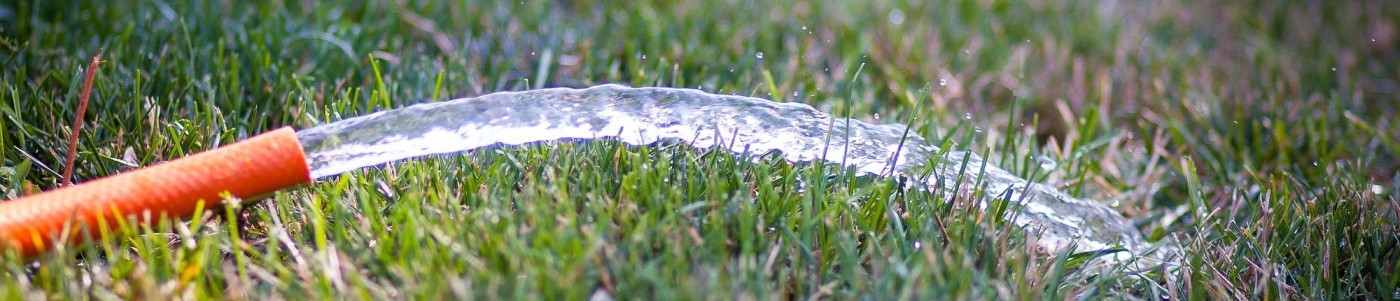
Establishing your new lawn is our business. The grading, feeding, mulching, and seeding have all been done for you! Now you must try to keep the ground sloppy wet until grass appears.
- Watering:
- For grass seed to germinate, it must stay moist continuously for four to eight days.
- For the first seven days water twice each day. Usually 25–30 minutes on each section of the lawn is about right, but your lawn may need more or less time, depending on slope, soil conditions, and weather. Hot weather may require more frequent watering, for example, and a sloping lawn may need longer, slower watering because of runoff. The lawn should be saturated—wet enough that you can’t walk on it without leaving footprints. You may want to start your watering at the point that’s farthest from the house and work in, to avoid walking on the sloppy wet lawn.
- After the first seven days, water heavily, but only those areas where grass is not visible. Where grass has appeared, limit watering to one inch a week, preferably in the morning hours.
- After grass stand is established, normally three to four weeks, water as you would an established lawn, about an inch each week, preferably in the morning hours. You can judge the amount by placing a flat pie pan or similar container in the area being watered. When an inch of water has collected, that area has had enough water, and you are ready to go on to the next area.
- Mowing:
- Mow your lawn as soon as it reaches a height of three and a half inches.
- Make sure your mowing blades are sharp.
- Set your mowing height at three inches and leave it there.
- Bag the clippings. Do not rake newly seeded lawns.
- Mow your lawn on a regular basis, every seven to ten days.
- Fertilizing:
- The fertilizer applied with the initial seeding will carry the lawn for the initial growth period.
- Due to the lack of topsoil, your lawn will have to be fertilized about six to seven weeks after sodding.The grass may show spots of yellowing, a sign of nitrogen deficiency. This is because, as nitrogen moves through the soil, the heavy watering necessary on a newly seeded area leaches the nitrogen out of the root zone. Also, new lawns, freshly backfilled and graded, are often not uniform in soil type and structure, or in fertility; this can also contribute to yellowing of the lawn in spots. Unless the weather is hot and dry, a supplementary application of nitrogen when these spots appear will boost the grass toward quicker maturity. Lawns need to be fertilized four to five times a year to become thick and lush.
- Weed Control:
- Weeds often appear in a new lawn, especially one that is planted in the spring. The presence of these weeds sometimes initiates frantic efforts to eliminate them, when in fact, they might be better left alone. Many of the weeds that accompany grass germination in the spring are annuals, whose seed is constantly present in the soil. If they naturally grow tall, regular mowing will be enough to control them. If they are low-growing varieties, such as crabgrass, they will likely stay in the lawn until fall, at which time their life cycle ends. Although they do compete with the grass, normally the grass plants will coexist with these weeds, and the following spring their germination can be chemically prevented. Spraying weeds with chemicals in new grass is risky, since immature grass is susceptible to chemical damage.
- If chemicals need to be applied, as in the case of dandelions or other low-growing perennials, take care to follow the manufacturer’s directions to the letter.
For more information on weed and insect control, and other lawncare questions, contact a lawn care professional, or take a look at the website of the Scotts Company.